
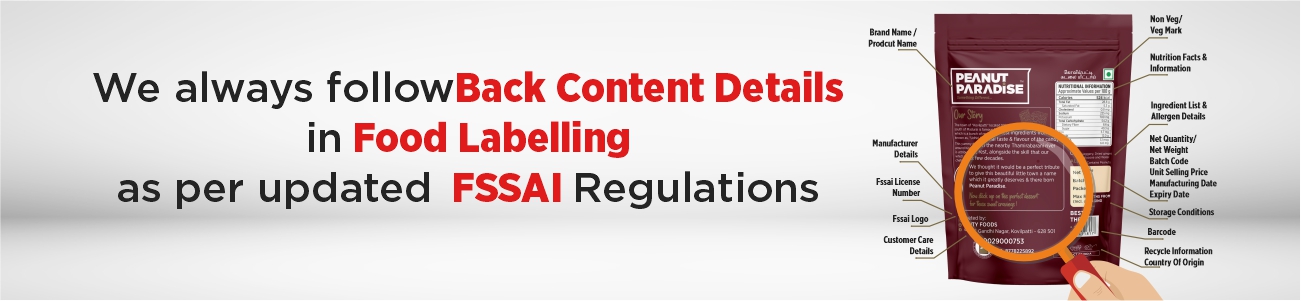
FSSAI Back Content in Food Labelling Design
A Complete Guide for Modern Food Brands (2025
Updated)
When consumers pick a food product from a retail
shelf, the front design captures their attention but it is the back-content information that builds
trust.
In India, every packaged food product must
follow the Food Safety and
Standards Authority of India (FSSAI) labelling guidelines.
These rules ensure transparency, safety, and accuracy regarding what consumers
eat.
For food brands, manufacturers, and product packaging design companies,
understanding and implementing these guidelines is essential for:
·
Market approval
·
Brand credibility
·
Legal adherence
·
Smooth entry into retail and export markets
This guide explains every mandatory element required on the
back panel, as
per the latest FSSAI Labelling & Display Regulations (2020, updated up to
2024).
Why Back Content as per FSSAI Guidelines Matters More Than Ever
The food industry is evolving rapidly, and so
are consumer expectations. Well-designed packaging that meets FSSAI regulations
helps brands:
·
Avoid penalties, rejections, and product recalls
·
Build consumer trust through transparency
·
Strengthen brand reputation
·
Improve acceptance in supermarkets and online
marketplaces
·
Demonstrate professionalism and regulatory
awareness
Complete List of Mandatory Back-Content Details (As per FSSAI
Regulations)
1. Brand Name / Product Name
The product name must clearly identify the
food item.
It should not mislead consumers or falsely represent the product category.
2. Manufacturer Details
Every package must clearly display:
·
Name of the manufacturer
·
Full factory address
·
Packer or importer details (if applicable)
This ensures traceability and consumer
confidence.
3. FSSAI License Number
A valid 14-digit
FSSAI License or Registration Number is mandatory.
This allows verification through official regulatory systems.
4. FSSAI Logo
The official FSSAI logo must be printed near
the license number for easy identification.
5. Consumer Care Details
Each food package must include a Consumer Care Cell,
containing:
·
Email address
·
Phone number
·
Postal address (recommended)
This supports grievance redressal as required by FSSAI guidelines.
6. Veg / Non-Veg Symbol
A mandatory symbol must indicate product type:
·
Green
dot – Vegetarian
·
Brown
dot – Non-Vegetarian
The symbol should be clearly visible on the
package.
7. Nutrition Facts Panel
As per Schedule II of the regulations, the
nutrition table must include:
·
Energy (kcal)
·
Protein
·
Carbohydrates (including sugars)
·
Total fat
·
Saturated fat
·
Trans fat
·
Sodium
·
Additional nutrients if claims are made
The panel must follow the prescribed format
and remain legible.
8. Ingredient List &
Allergen Declaration
Ingredients must be listed:
·
In descending order of weight
·
Using appropriate class names
Major allergens such as milk, soy, gluten, peanuts, tree nuts,
sesame, and eggs must be clearly declared.
Example:
Contains: Peanuts, Milk Solids
9. Net Quantity / Net Weight
The label must state the exact quantity of
food inside the package, excluding the packaging material.
10. Batch / Lot / Code
Number
Mandatory for traceability and quality control
as per labelling rules.
11. Maximum Retail Price
(MRP)
MRP must be printed according to Legal Metrology requirements
and should include all applicable taxes.
12. Manufacturing Date &
Expiry / Best Before Date
The package must clearly display:
·
Date of Manufacture
·
Date of Packaging (where applicable)
·
Best Before or Use-By Date
Dates should follow a clear and readable
format.
13. Storage Conditions
Essential for maintaining product quality and
safety, especially for:
·
Dairy products
·
Snacks
·
Beverages
·
Bakery items
Example:
Store in a cool, dry place. Keep away from
direct sunlight.
14. Barcode / QR Code
While not mandatory, these are widely used
for:
·
Retail scanning
·
Inventory management
·
Product authentication
·
Traceability
Many brands use QR codes to share product or
company information.
15. Recycling Information
& Country of Origin
Required details include:
·
Recycling or disposal symbols
·
Sustainability instructions
·
Country of origin declaration (e.g., “Made in
India”)
These elements support environmental
responsibility and international labelling expectations.
How Proper Back Content Builds Customer Trust
Packaging that meets FSSAI regulations
improves:
·
Retail and marketplace acceptance
·
Confidence among health-conscious consumers
·
Professional brand perception
·
Transparency and reliability
A well-structured back panel reassures
customers that the brand values safety and honesty.
Why Back-Content Design Is Crucial in Product Packaging
Design
While front visuals attract buyers, back
content:
·
Educates customers
·
Helps them compare products
·
Reduces confusion and complaints
·
Improves overall packaging quality
·
Adds perceived product value
Clear typography, spacing, and hierarchy play
a key role in readability.
How Rainbowgraph Delivers Product Packaging
Design as per FSSAI Guidelines
At Rainbowgraph,
every product packaging design project includes:
·
Label design drafting aligned with current FSSAI rules
·
Clean and structured back-content layouts in
product packaging design
·
Proper nutrition, ingredient, and allergen
formatting in back content of product packaging design
·
Barcode and recycling guidance in product
packaging design
·
Retail and export ready labelling design
standards
This approach helps brands avoid regulatory
risks while building long-term trust.
Final Thoughts
Back content of product packaging design
prepared as per FSSAI guidelines
is not just a legal necessity, it is a branding opportunity. When executed correctly,
it enhances credibility, improves customer confidence, and positions your
product packaging design as trustworthy and professional.